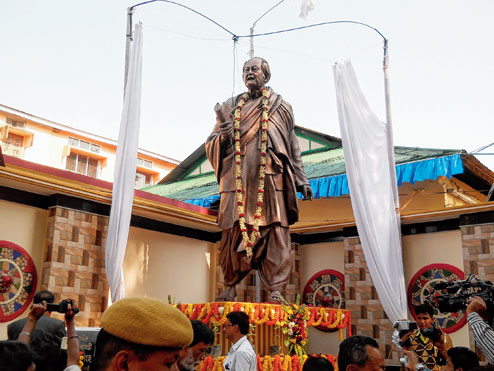
Sarat Chandra Singha Former CM of Assam
Compiled and Edited By Surjit Singha
Sarat Chandra Singha (1 January 1914– 25 December 2005) ethnically born to Koch Rajbongshi (Koch) Tribe, was a Chief Minister of Assam and a leader of Indian National Congress, Indian National Congress (Socialist) and Nationalist Congress Party.
He was known for his value-based politics, Singha belonged to a rare breed of politicians who sacrificed his life for the welfare of the downtrodden people of Indian society. A true Gandhian, he never compromised with his principle what he preached and practiced. His illustrious political life was a rare combination of honesty, simplicity, and integrity. He was also a writer.

Early life and education
Born on 1 January 1914 to a farmer’s family in Bhakatpara village of Chapar under Dhubri district, of Koch Dynasty (Presently Assam), Singha started schooling from his village school. For secondary education, he attended a High School in Bilasipara Indra Narayan Academy higher secondary school, some 25 km from his home, a distance what he covered daily on foot or by bicycle.
He received his bachelor’s degree from the Cotton College, Guwahati and subsequently moved to Banaras Hindu University for law education. After receiving a law degree, Singha came back to Guwahati and practiced law for a short period and then switched to school teachings in different positions from assistant teacher to the headmaster in Dhubri district. During the reorganization of States on the basis of languages in the early 50s, a section of people in Western Assam tried to merge the undivided Goalpara district with West Bengal. But Singha fought the move alone and kept Goalpara district well embedded within the geographical boundary of Assam.
Political career
Singha entered politics in 1946 through Indian National Congress and elected to Assam state assembly four times from Bilasipara east constituency in 1946-52, 1962–67, 1972–78 and 1985-90.
He was first made an interim Chief Minister in 1972 by Indira Gandhi and subsequently became an elected chief minister and served till 1978. He also served the Congress Party in various positions and capacities like the general secretary, vice-president, and president. However, he later joined Indian National Congress (Socialist) after the emergency era which was imposed by Indira Gandhi and became the national president of it in 1987.
Singha faced some challenging task in his tenure of chief minister-ship like shifting the state capital from Shillong to Dispur when Meghalaya was carved out of Assam along with Shillong and the language agitation in 1972, which rocked the state, a demand for the introduction of Assamese as the sole medium of instruction in Assam.
He was instrumental in setting up the Guwahati Medical College and Hospital and Bongaigaon Refinery and Petrochemicals Limited. He believed in the decentralization of power and introduced Panchayati Raj in the State for the welfare of the backward communities. He also sowed the seeds of the cooperative movement in Assam to boost State’s economy.
When Sharad Pawar left the Congress to form the Nationalist Congress Party, he joined him and led the party in Assam till his death. A man of the masses, Singha became a living legend during his lifetime. He was the most common man in an uncommon society.
Like a young man at the age of 90, he attended literary discussion, drama workshop, dharna, hunger strike or trade union meeting. He died on 25 December 2005 at his Guwahati residence due to old age ailments.
Singha played a major role not just in preventing Undivided Goalpara district from being clubbed with East Pakistan during Partition, but also from being included in West Bengal. He failed, however, despite putting up a tough fight, in preventing Cooch Behar and Jalpaiguri — originally part of Koch Dynasty — from being merged to West Bengal.

Old Undivided Goalpara Districts, Bijni State, Sidli State, Beltola State, Darrang State which was ruled by the Koch Tribe are presently part of Assam and Cooch Behar Princely State which is presently part of West Bengal was originally part of the Koch Dynasty alias the Kamatapur Kingdom before being merged with the dominion of India.
It happened nearly three decades ago. Sharad Pawar, then a Congress leader, was with party colleagues at Azad Maidan in Mumbai, where an AICC session was to begin that afternoon. He noticed a tall, lean man walking towards them from the Victoria Terminus (now CST) railway station. The man had a suitcase in one hand and bedding on his head. As he walked up to the group, a stunned Pawar realized it was Sarat Chandra Singha, the Chief Minister of Assam! He had traveled for more than two days in a third class railway compartment from Guwahati because that was all he could afford. The AICC session was not a government function, and so he couldn’t have used the resources of his state.
The anecdote is part of a chapter in Sharad Pawar’s autobiography, On My Terms: From the Grassroots to the Corridors of Power.
Pawar’s experience was not his alone. “He (Singha) was made of a different material altogether. Who would now believe that Singha had picked up his suitcase and walked 5 km from the CM’s bungalow to his private residence as news came that the Congress had lost the 1978 Assembly elections, journalist Homen Bargohain wrote in his newspaper column at the time of Singha’s death.
Singha’s father Lalsingh Singha ensured that his son always carried his slate and pencil while accompanying him to the paddy fields. Little Sarat learned his arithmetic tables by counting his and his father’s footsteps to the weekly village market. “Sometimes he would ask me to multiply the footsteps, sometimes divide,” Singha had said, recalling his childhood in a lengthy interview with All India Radio, Guwahati, about 30 years ago.
He was a true Gandhian who wore khadi, and taught his students the art of making paper from straw. After becoming CM, he often spent his spare time in the CM’s bungalow in Guwahati by sewing national flags out of khadi cloth he would procure from the local khadi bhandar.
“I would often find him continue to sew national flags even when taking briefs from senior officers like Gandhiji used to work on his charkha,” recalled JP Saikia, a journalist-turned-bureaucrat who served as a senior publicity officer under Singha. At the time of the Emergency, he turned his creative energies to what was then the Congress line — coming up with slogans, jingles and, most interestingly, a list of 20 different things that citizens ought to do, each beginning with a letter of the word ‘twenty-point-programme’ which itself had 20 letters, Saikia said.
Singha, who was an aggressive village-level organizer in undivided Goalpara district — setting up schools and cooperative samitis and organizing campaigns against liquor and opium — entered politics rather by accident. “Elected to the Dhubri local board in 1945, Singha was literally taken to Guwahati by veteran Congress leader Mahendra Mohan Choudhury (who later served as Chief Minister of Assam and Governor of Punjab), who then got him a Congress ticket to contest the state Assembly election of 1946. The party had given him Rs 750 as election campaign expenses, but on completion of the campaign, he duly went and returned Rs 250 that remained unspent,” wrote Khagendra Nath Baishya, a former Secretary of the Assam Legislative Assembly.
Another story is about Singha at the first sitting of the Assembly 20 days after Independence. “Even as (the) Speaker… announced the first day’s proceedings with a resolution of gratitude to Mahatma Gandhi…, the 33-year-old Singha stood up, raised a point of order and said that the legislators ought to take oath once again because when they had first joined the House, the oath was taken under a foreign government,” wrote Baishya.
Singha played a major role not just in preventing Goalpara district from being clubbed with East Pakistan during Partition, but also from the district being included in West Bengal. He failed, however, despite putting up a tough fight, in preventing Cooch Behar and Jalpaiguri — originally part of Koch Dynasty — from going to West Bengal.
Singha was a strong believer in, and practitioner of value-based politics. Old-timers in Guwahati still remember two sights. One, television visuals of Singha clearing knee-deep water from his house after a heavy downpour. And two, a dhoti-clad old man vacating his seat for women commuters in a city bus. These images are now part of a gradually disappearing folklore in Assam, as people and the media keep talking about the assets of politicians jumping several times every time there is an election.
Former CM statue unveiled as a centenary tribute – First sculpture of Assam’s ‘illustrious son’ installed in heart of Dhubri on Swahidi Diwas

The statue of Sarat Chandra Singha was unveiled on 10 December 2013, in Dhubri town. Dhubri paid tribute to its illustrious son, Sarat Chandra Singha, just ahead of his birth centenary by unveiling his first statue in Assam on Swahidi Diwas (Martyrs’ Day), today.
The statue of Assam’s fifth chief minister was unveiled by Dhubri deputy commissioner Kumud Chandra Kalita in the heart of the town, opposite Dhubri circuit house and the office of the superintendent of police.
Kalita said he was highly inspired by Singha’s humbleness and simplicity. Recalling his university days, he said he often used to meet Singha in Guwahati’s buses and vacated his seat for the jananeta (leader of the masses).
“It is a great privilege that I have got the opportunity to unveil the statue of this great, down-to-earth man. He was the son of this district, a farmer’s son who fought hard to bring revolutionary changes in the fields of co-operative movement, Panchayati raj, and the land ceiling act,” he added.
Kalita said it was time to rediscover the ideology, principles, and philosophy of the charismatic leader. “This statue will definitely act as a symbol of inspiration for the coming generation,” he added.
Addressing the meeting, Kalpana Roy Singha, wife of Major (retd) Prasanta Kumar Singha, the second son of the former chief minister, recalled the days she had spent with him. She said her father-in-law was a very different man.
“It is not easy to define him because it is not possible to express everything in a speech or even a book. He led a simple life without troubling others but remained deeply concerned about the common people. He made every effort to eradicate poverty,” said Roy Singha, who is the head of the department of physics at Assam Engineering College.
Talking to The Telegraph, Major Singha said he was very pleased with the initiative and efforts of the Dhubri DC and the local people. “But we will be more pleased if we see the next generation following his principles and if it helps to uplift the underprivileged. My father will remain a father to me and not the former chief minister. I have been following his teachings and moral values of life and ethics,” he added humbly.
Earlier, Haider Hussain, litterateur, and journalist who released a souvenir Sarat Smriti, spoke at length on the life and politics of Sarat Chandra Singha and his association with him. Sarat Smriti has been jointly edited by Upendrajeet Sarma, a professor at BN College, and Joydeep Barua, journalist and social worker.
“Singha was an unparalleled leader and his every step was for the betterment of society. He was least concerned about himself and had discarded all comforts of life. It is unbelievable how a man of his stature could lead such a simple life with a strong belief in himself. Singha has to be rediscovered for his deeds,” Hussain added.
Sarat Chandra Singha College of Agriculture

Sarat Chandra Singha College of Agriculture (SCSCA) had its origin in the Faculty of Agriculture, Assam Agricultural University, Jorhat. The college functioned from Faculty of Agriculture, Jorhat during first 4-years of its existence. The foundation stone of the college was laid at Rangamati on 7th of February, 2009 by the then Chief Minister of Assam Dr. Tarun Gogoi, Hon’ble in presence of a hosts of Ministers including the former Minister of Agriculture & WTP Smt. Pramila Rani Brahma. The full-flagged campus of SCSCA, Dhubri was inaugurated on 22nd August 2014. Dr. Ranjit Sarma was appointed as the first Associate Dean of the college. The Academic Session of SCSCA was also started at its own campus from August 2014 itself and enrolled the 5th batch comprising of 25 numbers of students for a 4-year Degree Programme leading to B Sc. (Agri.) degree. As the permanent campus of the college at Rangamati in Dhubri district was inaugurated on 22nd August 2014, the Foundation Day of the college is celebrated every year on 22nd August.
Goal and Objectives
1) The goal of the college is to generate technically sound quality human resource in the Agricultural & allied sectors, also to generate ground-breaking agricultural technologies and dissemination of the same through extension activities for the improvement of the socio-economic condition of the farming communities of Assam on a sustainable basis.
2) To achieve the goal of the college, the specific objectives are to produce globally competitive B. Sc. (Agri.) graduates and active involvement of faculty in technology generation and dissemination process.
Eligibility for Admission
Admission is strictly on merit basis and on the criteria as prescribed by the Academic Council, AAU from time to time. A candidate who has passed 10+2 examination in Science stream or an equivalent examination with Physics, Chemistry and Biology (or Botany and Zoology in place of Biology) of recognized University or Board securing 50% marks (45% for SC/ST candidates) in aggregate is eligible for admission. Also, the candidate should not be less than 17 years of age on the last date of submission of application.
Counseling and admission of the selected student are carried out as notified by the AAU authority.
Academic Programme
The College offers B.Sc. (Agri.) Degree Programme, which is of 8 (eight) semesters (minimum 4 years) including one semester for Rural Agricultural Work Experience Programme (RAWEP) and one semester for Experimental Learning Programme (ELP) as per Academic Regulation of Assam Agricultural University, Jorhat.
Learning Resources
1) Library (Plinth area: 625.69 sq. m.)
2) Class rooms (Plinth area: 635.78 sq. m.)
3) Laboratories (Plinth area: 72 sq. m. each)
4) Instructional Farm (Area: 75.6 ha)
Reference:
Kashyap, S. G. (2018, February 13). Polls ahead, why an Assam CM from 40 years ago is relevant again. In The Indian Express. Retrieved October 26, 2016, from https://indianexpress.com/article/explained/polls-ahead-why-an-assam-cm-from-40-years-ago-is-relevant-again/
Sarat Chandra Singha College of Agriculture (n.d.). In Assam Agriculture University. Retrieved October 13, 2018, from http://www.aau.ac.in/colleges/name/sarat-chandra-singha-college-of-agritulture/3
Sarat Chandra Singha dead (2005, December 25). In Outlook. Retrieved October 13, 2018, from https://www.outlookindia.com/newswire/story/sarat-chandra-sinha-dead/344241
Sharma, B. K. (2013, December 11). Former CM statue unveiled as centenary tribute – First sculpture of Assam’s ‘illustrious son’ installed in heart of Dhubri on Swahidi Diwas. In The Telegraph. Retrieved October 13, 2018, from https://www.telegraphindia.com/states/north-east/former-cm-statue-unveiled-as-centenary-tribute-first-sculpture-of-assam-s-illustrious-son-installed-in-heart-of-dhubri-on-swahidi-diwas/cid/233993
Last Updated: 14 October 2018
Project: Koch

